Thursday, August 5, 2010

Quantum Numbers

QUANTUM NUMBERS 


1)The Principle Quantum Number "n" :  This quantum number was the first one discovered and it was done so by Niels Bohr in 1913. Bohr thought that each electron was in its own unique energy level, which he called a "stationary state," and that each electron would have a unique value of 'n'

               :In this idea, Bohr was wrong. It very quickly was discovered that more than one electron could have a given 'n' value. For example, it was eventually discovered that when n=3, eighteen different electrons could have that value.


               :Keep in mind that it is the set of four quantum numbers that is important. As you will see, each of the 18 electrons just mention will have its own unique set of n, l, m, and s.


               :Finally, there is a rule for what values 'n' can assume. It is:
n = 1, 2, 3, and so on.

       : n Will always be a whole number NEVER less than one.
          :One point: n does not refer to any particular location in space or any particular shape. It is one component (of four) that will uniquely identify each electron in an atom.    
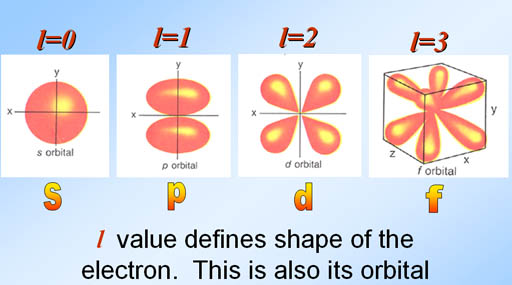
2) The Azimuthal Quantum Number "l" about 1914-1915, Arnold Sommerfeld realized that Bohr's 'n' was insufficient. In other words, more equations were needed to properly describe how electrons behaved. In fact, Sommerfeld realized that TWO more quantum numbers were needed.  

                 :The first of these is the quantum number signified by 'l.' When Sommerfeld started this work, he used n' (n prime), but he shifted it to 'l' after some years. I'm not sure why, but it seems easier to print l than n prime and what if the printer (of a textbook) accidentally dumps a few prime symbols, leaving just the letter 'n?'


                 :The rule for selecting the proper values of 'l' is as follows:
l = 0, 1, 2, . . . , n-1

                 :l will always be a whole number and will NEVER be as large as the 'n' value it is associated with.


3) Magnetic Quantum Number "ml"
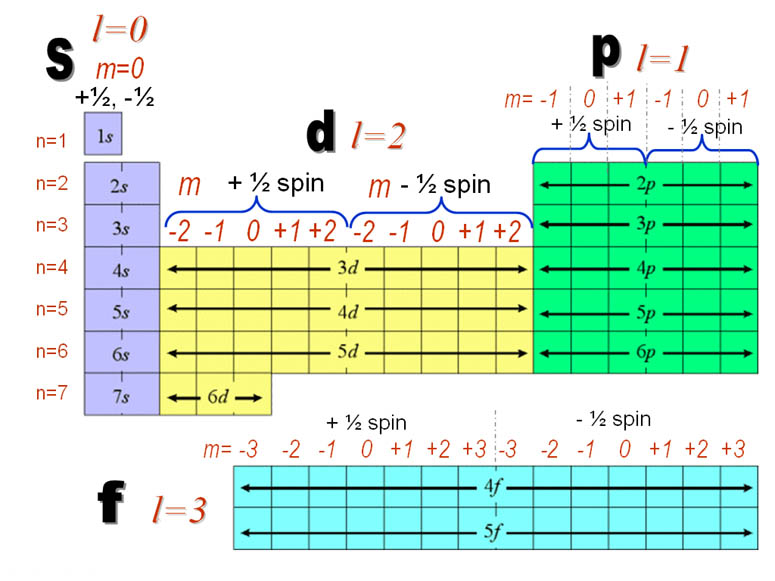
Specifies the orientation in space of an orbital of a given energy (n) and shape (l). This number divides the subshell into individual orbitals which hold the electrons; there are 2l+1 orbitals in each subshell. Thus thes subshell has only one orbital, the p subshell has three orbitals, and so on.
 
4) Spin Quantum number "ms" : Specifies the orientation of the spin axis of an electron. An electron can spin in only one of two directions (sometimes called up and down).
         : The Pauli exclusion principle (Wolfgang Pauli, Nobel Prize 1945) states that no two electrons in the same atom can have identical values for all four of their quantum numbers. What this means is that no more than two electrons can occupy the same orbital, and that two electrons in the same orbital must have opposite spins


            : Because an electron spins, it creates a magnetic field, which can be oriented in one of two directions. For two electrons in the same orbital, the spins must be opposite to each other; the spins are said to be paired. These substances are not attracted to magnets and are said to be diamagnetic. Atoms with more electrons that spin in one direction than another contain unpaired electrons. These substances are weakly attracted to magnets and are said to be paramagnetic.


ATOMS


SUB ATOMIC PARTICLES
  • Particles that are smaller than the atom.
  • Small particles composing of nucleons and atoms.
  • 3 main sub atomic particles that make up the atom are the Protons, Neutrons and Electrons.
Eugene Goldstein.
PROTONS
  • Positively charges sub atomic particles.
  • The existence of protons was first discovered by Eugene Goldstein in 1886.
  • He observed a cathode ray tube and found rays traveling in the direction opposite to that of the cathode rays. He called those canal rays and concluded that they were composed of positive particles. He called those canal rays and concluded that they were composed of positive particles. 
  •   Each proton has a mass about 1840 times that of an electron.
Model of the Canal Rays Goldstein observed.


ELECTRONS
  •  Negatively charged subatomic particles.
  • Discovered by J. J Thomson in 1897.
  •   Thomson performed experiments wherein high voltage electricity was applied across electrically charged plates in a cathode ray tube containing a very small amount of gas, a ray coming from the negatively charged electrode, the cathode was observed.
Cathode Rays observed by J.J Thomson


NEUTRONS
    James Chadwick
  • Neutrons are sub atomic particles with no charge but with a mass nearly equal to the proton's.
  • Sir James Chadwick confirmed the discovery of another atomic particle’s existence: the Neutron.
NOTE:
ü  All atoms are made up of subatomic particles protons, neutrons and electron.
ü  The electronic charge is measured in coulombs (C).


ATOMIC NUMBER (Z)
  • Indicates the number of protons and defines the element.
Example: 


<--- Gold's Atomic Number is 79. It has 79 protons and electrons and is also the 79th element in the periodic table :D


ATOMIC MASS (A)
  •        The average mass of an atom of an element.

 Gold's Atomic Mass is 197 :D (Remember to round off decimals)---->


A.Z.P.E.N
  •          AZPEN stands for Atomic Mass(A), Atomic Number(Z), Proton(P), Electron(E), 
    Neutron (N)

    Example:

* A chart that makes us see a more organized data for each element.

IONS
  •          Atoms or groups with a positive or negative charge.
  •          Formed when electrons are removed or added to a neutral atom, a charged particle of the same element is formed.
  •          An ion with a positive charge is called a cation.
  •         An ion with a negative charge is called an anion.


ISOTOPES
  • Atoms that have the same number of protons and electrons but they each have different number of neutrons.
  •            Atoms that have the same number of protons but different numbers of neutron.
Example:


Isotopes of Magnesium
Lithium-6
Lithium-7
Lithium- 8

Submitted By: Group 5
Mia San Juan
Alex Vergara
Cierra Mortega
Jhoanne Sanchez
Elma Tejada


ASPECTS OF MATTER

What is Chemistry?

Chemistry is the study of matter, its properties, and the changes it undergoes. It is called the Central Science because there is hardly any aspect of life untouched by it. It taps into various fields of science, such as complex studies such as Pharmacology, Toxicology, and Medicine and even explains simple daily activities such as cooking and cleaning.


What is Matter?
 
Matter is what makes up material objects; it is anything that takes up space and has mass, meaning it could be weighed. It contains atoms and molecules, which are constantly moving. The amount of energy (or movement) that atoms and molecules have influences their interaction with each other.

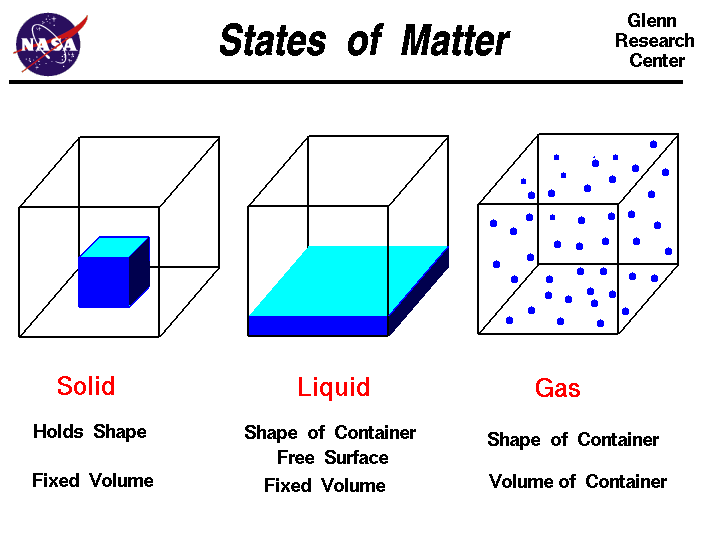
The three common states of matter are solid, liquid, and gas. Solids are ordinary objects which retains its shape and volume no matter its location, due to its particles being tightly packed together and in fixed positions. Liquids occupy a definite volume but assumes the shape of the occupied portion of its container. This is so because its particles are close together, but are free to move about. Gasses matains neither its shape or volume. It expands to fill completely the container it occupies. Gases flows and are easily compressed, due to its particles moving in a rapid random motion and being far apart. The other two states of matter are plasma and Bose-Einstein Condensates. Plasmas are hot, ionized gases, formed under conditions of extremely high energy, so high, in fact, that molecules are ripped apart and only free atoms exist. Bose-Einstein Condensates is when all the atoms of the condensate attain the same quantum-mechanical state and can flow past one another without friction. These condensates are gaseous superfluids cooled to temperatures very near absolute zero.
 

ASPECTS OF MATTER

1. Changes

Response to a reaction; to form, to create.

2. Composition

Elements present or found in a piece of matter.

3. Application

How is is used and how it is beneficial.

4. Laws and Principles

The reason behind the change or observation.

5. Characteristics

Structure and form.

A BRIEF OUTLINE ON THE HISTORY OF CHEMISTRY

Prehistoric Chemistry

People used fire to bring about change.

2, 500 years ago

Greek philosophers were the first to formulate theories--explanations on the behavior of matter.


C. E. 500 - 1500

The experimental roots of chemistry, Alchemy (a mixture pf magic and chemistry), was propagated. Alchemists sought after the philosopher's stone, that would turn cheapers metals into gold, and an elixir that would confer immortality to those exposed to it. 


Middle of 20th Century 
Francis Bacon, a judge, had the Baconian Dream, where in science could solve the world's problems. 

Modern Chemistry 

Chemists can now transform matter in ways that would astound alchemists, like changing crude oil to plastics, fibers, pesticide, drugs, and detergents. 


FIVE MAJOR BRANCHES IN CHEMISTRY
 
1. Organic Chemistry

Organic chemistry deals with all carbon compounds. Carbon is the basis of all life. This is important to petrochemica, pharmaceutical, and textile industries. This also studies living organisms, for they are made of cells.

2. Inorganic Chemistry

Inorganic chemistry deals with non-carbon compounds. Most acids, bases and salts are non-carbon based. Mineral compounds are also included in inorganic chemistry. Hydrochloric acid, sodium metal, oxygen gas and the noble gases are all part of inorganic chemistry.

3. Analytical Chemistry

Analytical chemistry is concerned with the composition of substances. For instance, an analytical chemist might analyze a sample of blood to see if there is poison present and determine the type of poison.
  • Qualitative - Identifies all the atoms and molecules present.
  • Quantitative - Amount of each component is determined. 


4. Physical Chemistry

Physical chemistry deals with the theoretical basis for the behavior of chemical substances cause of the change that occur. It provides the basis or background for the other types of Chemistry.


5. Biochemistry

Biochemistry studies the processes and compounds important to life. It is closely related to organic chemistry. It studies metabolic processes and reactions like digestion and blood clotting, and biochemical compounds such as carbohydrates, proteins, lipids, nucleic acids.


MADE BY
Michaela Panaguiton and Nadine Leano.


Wednesday, August 4, 2010

ATOMS.

ATOMS 
 

SUB ATOMIC PARTICLES

PROTONS

-         It is found in the nucleus of each atom, along with neutrons.
-         The proton is a subatomic particle with an electric charge of +1.
-         Protons and neutrons are both nucleons, which may be bound by the nuclear force into atomic nuclei.
-         Positively charged (+)

NEUTRONS

-         subatomic particle with no net electric charge and a mass slightly larger than that of a proton.
-         found in atomic nuclei.
-         The nuclei of most atoms consist of protons and neutrons, which are therefore collectively referred to as nucleons.
-         The number of protons in a nucleus is the atomic number and defines the type of element the atom forms.
-         The number of neutrons is the neutron number and determines the isotope of an element.

ELECTRONS

-         The electron was identified as a particle in 1897 by J. J. Thomson and his team of British physicists.
-         The electron is a subatomic particle carrying a negative electric charge.
-         It has no known components or substructure, and therefore is believed to be an elementary particle
-         An electron has a mass that is approximately 1/1836 that of the proton.
-         The antiparticle of the electron is called the positron, which is identical to the electron except that it carries electrical and other charges of the opposite sign.
-         An electron in motion relative to an observer generates a magnetic field, and will be deflected by external magnetic fields.


IONS AND ISOTOPES

IONS

-          Ions are atoms with charges, this is when atoms lose or gain electrons.

-          To form ions, it is the electrons in the highest energy level that are gained or lost. When electrons are gained, the ion has a negative charge and is called an anion. When electrons are lost, the ion has a positive charge and is called a cation.

-          This may seem backwards in terms of losing something becoming more positive and gaining something becoming more negative, but if you remember that electrons have a negative charge, what is being added or lost have a negative value.


Cations: when an electron loses electrons, it gets more positive (+)
Anions: when an electron receives electrons, it gets more negative (-)

Example:
                                             2e
Carbon: 6 electrons -----------------------------à Carbon: 6 electrons
It becomes:

Carbon: 4 electrons -----------------------------à Carbon: 8 electrons
                        ^                                                                                ^
since it lost electrons (2)                              since it gained electrons(2)
            it is now a cation. (+) it is                              it is now an anion. (-) it is more        now less negative, so it is                                 negative.
            more positive.


ISOTOPES

-     this is when the atomic mass changes, specifically the neutron.
-          Atomic mass is equal to protons + neutrons. Protons don’t change because it means, the element would change, since it is equal to the atomic number. In isotopes, the number of neutrons changes.

Example:

A.   atomic mass:   12 Carbon        6 protons        6 electrons     6 neutrons

B.   atomic mass: 11 Carbon        6 protons        6 electrons     5 neutrons

C.   atomic mass: 14 Carbon        6 protons        6 electrons     8 neutrons

-          Atoms B and C are what you call the isotopes of Carbon.


Created by: 
Cruz, De los Reyes, Groves, 
Lorenzo and Villarosa II-9. :)